Biblical Studies

Biblical Studies

Through their work in Biblical Studies, students will develop knowledge and understanding about the main events and people in biblical history through to the present day; the flow of major themes through the Bible from Old Testament to New Testament; the centrality of Christ to the prophecies, events and focus of the biblical record; the various types of literature which make up the writings of the Bible; theological terms and concepts as they are used in the Bible; and a biblical perspective on issues facing Christians today.

PREREQUISITES AND COURSE REQUIREMENTS

There are no prerequisites for this subject. Biblical Studies is a school-based course and is compulsory for all students. Biblical Studies does not contribute to an ATAR.

YEAR 11 COURSE

  1. Doctrine: Big Questions Students explore a systematic theology and apply biblical understanding to everyday practical situations by asking the following "big questions": Is God good? Why is there suffering? Will God do as he has promised? Is God in control?
  2. The Air We Breathe Students explore the impact of Christian history upon the modern world. Key questions focus on how modern society has come to believe in freedom, kindness, progress and equality and how these modern values have their origin in the life and teachings of Jesus Christ. Christian values have become The Air We Breathe.
  3. Ephesians Students explore the Apostle Paul's letter to the church in Ephesus. Key themes centre on God's grace in reconciling his people, uniting his church as one body and calling Christians to let the Gospel story reshape our lives for his plans.

YEAR 12 COURSE

  1. Christian Ethics This unit explores some key issues facing Christians in the modern world, which may include the environment, politics, science and technology, pain and suffering. Students evaluate the authorities they turn to for big life decisions: Scripture, Tradition, Experience, Reason.
  2. Doctrine: Big Answers Students will explore a systematic theology in answer to the key Christian doctrines of Salvation, Grace, Sanctification and things to come.
  3. Church History Students explore key theological developments throughout 2000 years of church history. This unit examines Christianity's legacy, highlighting both its negative impacts and its often-overlooked positive contributions throughout history.
  4. Christian Living Students explore key teachings in Philippians and James on Christian living. Key focus is given to spurring one another to growth, fixing our eyes on Jesus amongst difficult circumstances, and persevering with hope as we run the race of life.

BENEFITS AND APPLICATION

The aim of Biblical Studies is to enable students to acquire the biblical knowledge and understanding, skills, and values and attitudes essential for the development of a distinctively Christian worldview, and to prepare students for informed and active Christian living in a changing world.
English Department

English Standard

The English Standard course provides students with the opportunity to become confident and effective communicators, verbally and in writing. It enables students to increase their expertise in English to enhance their personal, educational, social and vocational lives. English Standard equips students for many areas of university study, as well as for other post-school options.

English Standard is the core Stage 6 English course.

PREREQUISITES

The English Standard course is designed for students with a diverse range of literacy skills. The course requires students to be willing to apply themselves to class tasks and homework, and to commit to prescribed and wide reading.

COURSE REQUIREMENTS

Students analyse and study a breadth and variety of English texts. These include quality literature from the past and contemporary texts from Australia and other cultures.

Students explore language forms, features and structures of texts in a range of academic, personal, social, cultural, historical and workplace contexts.

Across Stage 6, the selection of texts must give students experience of: quality literature; Australian texts; texts authored by Aboriginal and/or Torres Strait Islander Peoples; texts with a range of social, cultural and gender perspectives; and multimodal texts.

YEAR 11 COURSE

In the Year 11 course, students are required to:

  • study one complex multimodal or digital text or film
  • study one substantial literary print text (prose fiction, drama or poetry)
  • read widely to support their study.

The course has three focus areas:

  1. Reading to Write: Transition to English Standard
  2. Contemporary Possibilities
  3. Close Study of Literature

YEAR 12 COURSE

The Year 12 course requires the close study of three types of prescribed texts, one drawn from each of:

  • prose fiction
  • poetry or drama
  • film or media or non-fiction.

The course has four focus areas:

  1. Texts and Human Experiences
  2. Language, Identity and Culture
  3. Close Study of Literature
  4. The Craft of Writing

BENEFITS AND APPLICATION

This course will be of practical benefit in any future area of study or work as it enables the student to understand and respond to all forms of communication and to express thoughts and ideas clearly and articulately.

It provides the opportunity to consider and evaluate a variety of worldviews from a Christian perspective and to develop gifts such as imaginative writing skills and public speaking. These are of personal value and also form a basis for many ministry and career options.

English Advanced

Students are provided with the opportunity to pursue areas of interest with increased independence. Through extended engagement in investigations and compositions, students develop to a high level their critical, evaluative and creative skills. They develop independent and collaborative learning skills and higher-order critical thinking that are valued at tertiary levels of study and in the workplace

Students develop an increased awareness of the world in which they live and strengthen their ability to consider it from a Christian perspective.

PREREQUISITES

The English Advanced course is designed for students who have a particular interest and ability in English. Prospective students should have recorded strong performances in English in Stage 5.

The course requires students to be willing to engage with challenging written, spoken, visual, multimodal and digital texts that represent a changing world. They will be expected to read a range of prescribed texts, as well as conduct their own extensive wide reading.

Students must be prepared to commit themselves to rigorous study inside and outside the classroom and must be independent and critical thinkers.

COURSE REQUIREMENTS

Students will refine their understanding of the dynamic relationship between language, texts and meaning through critical study. They will make skilful and creative use of language forms, language features and structures in texts composed for different purposes in a range of contexts.

Students will develop the knowledge to question, reconsider and refine meaning through language and to reflect on their own processes of responding, composing and learning.

Across Stage 6, the selection of texts must give students experience of:

  • quality literature
  • Australian texts
  • texts authored by Aboriginal and/or Torres Strait Islander Peoples
  • texts with a range of social, cultural and gender perspectives
  • and multimodal texts

YEAR 11 COURSE

In the Year 11 course, students are required to:

  • study a range of texts chosen to prepare them for the Year 12 pattern of study
  • read widely to support their study.

The course has three focus areas:

  1. Reading to Write: Transition to English Advanced
  2. Narratives that shape our world
  3. Critical Study of Literature

YEAR 12 COURSE

The Year 12 course requires the close study of four prescribed texts, including at least one drawn from each of:

  • prose fiction
  • poetry or drama
  • drama or film or media or non-fiction.

At least one of the texts must be authored by Shakespeare.

The course has four focus areas:

  1. Texts and Human Experiences
  2. Textual Conversations
  3. Critical Study of Literature
  4. The Craft of Writing

BENEFITS AND APPLICATION

Students undertaking this challenging course will deepen their appreciation of the richness of English literature as they make detailed examinations of various novels, plays and poets.

They will refine their critical and evaluative skills and gain further experience in thinking about life issues from a Christian perspective.

English Extension 1 & 2

English Extension is designed for students undertaking English Advanced who are highly accomplished in English and choose to study at a more intensive level. They engage with complex levels of conceptualisation and seek the opportunity to work in increasingly independent ways.

The English Extension 1 course (Years 11 and 12) provides students with the opportunity to extend their use of language and self-expression in creative and critical ways. Students learn about research methodology to enable them to undertake extensive investigation and to develop extended compositions.

The English Extension 2 course (Year 12 only) enables students who are highly accomplished in their use of English the opportunity to craft language and refine their personal voice in critical and creative ways. They complete a complex author study and master skills in the composition process to create a substantial and original Major Work that extends their knowledge, understanding and skills developed throughout Stage 6 English courses.

PREREQUISITES

Extension 1 is designed for Advanced English students who are already performing at a very high level in their English studies. Students must have a personal interest in literature and a desire to pursue specialised study of English.

Extension 2 is designed for Advanced English students who are independent learners with an extensive interest in literature and a desire to pursue highly specialised study of English. Students must be self-motivated and interested in conducting their own research, as well as in the study of literary criticism and in producing a Major Work. All Extension 2 students must concurrently study Advanced English AND English Extension 1.

YEAR 11 EXTENSION 1 COURSE

The course has one mandatory section and a related research project.

Focus area - Texts, Culture and Value

Teachers prescribe ONE text from the past and its manifestations in one or more recent cultures. Students select ONE text and its manifestations in one or more recent cultures for their independent project.

YEAR 12 EXTENSION 1 COURSE

The course has one common focus, Literary Worlds , and one elective option.

Three texts must be studied from a prescribed text list, including two extended print texts.

YEAR 12 EXTENSION 2 COURSE

This course now has two focus areas: Author and Authority, and a Major Work. Students should note that this course now has a complex theory component, as well as a Major Work.

Students wishing to study Extension 2 must also study the Advanced and Extension 1 courses.

Students will:

  • undertake an extensive, independent investigation involving a range of complex texts
  • complete an author study
  • complete a year-long Major Work
  • write a reflection statement
  • document coursework in a Major Work journal.

BENEFITS AND APPLICATIONS

Students are provided with the opportunity to pursue areas of interest with increased independence. Through extended engagement in investigations and compositions, students develop to a high level their critical, evaluative and creative skills. They develop independent and collaborative learning skills and higher-order critical thinking that are valued at tertiary levels of study and in the workplace

Students develop an increased awareness of the world in which they live and strengthen their ability to consider it from a Christian perspective.

Mathematics Department

Mathematics Standard

Mathematics Standard 11–12 focuses on enabling students to use mathematics to make informed decisions in their daily lives. Students develop understanding and competence through real-world applications of mathematics.

Mathematics Standard 2 provides a pathway for students to extend their mathematical thinking through examining more complex content, and through applications and modelling. The Mathematics Standard 2 course offers students the opportunity to prepare for a wide range of educational and employment aspirations.

YEAR 11 AND 12 COURSE STRUCTURE

  • Algebra
  • Financial Mathematics
  • Measurement
  • Statistics
  • Networks

PREREQUISITES AND COURSE REQUIREMENTS

The outcomes and content in the Stage 6 Mathematics Standard syllabus are written with the assumption that students studying this course will have engaged with all core strands of Stage 5 and with the following path strands of Stage 5—financial mathematics, linear relationships, non-linear relationships, right-angled triangles (trigonometry), single variable data analysis and probability.

Consequently, content in the NSW Mathematics K–10 syllabus up to and including this level is also implicit in this syllabus. In a number of cases where content from Stage 5 is included, it is in the context of review for clarity and completeness.

HSC EXAMINATION

All students studying Mathematics Standard 2 will sit an HSC examination.

BENEFITS AND APPLICATIONS

This course has many practical applications as it examines the way that mathematics is related to everyday situations. It shows students the relevance of mathematics and promotes an understanding of mathematical concepts. This awareness allows students to have a greater appreciation of God’s work in creation.

The course is fully prescribed (no options) and is designed to support TAFE and other vocational courses.

It provides an appropriate mathematical background for students who do not wish to pursue the formal study of Mathematics at tertiary level, although many vocational courses which do not assume an extensive mathematical background may still be accessed.

Mathematics Standard 2 is designed for those students who want to extend their mathematical skills beyond Stage 5 but are not seeking the in-depth knowledge of higher mathematics that the study of calculus would provide. This course offers students the opportunity to prepare for a wide range of educational and employment aspirations, including continuing their studies at a tertiary level.

Mathematics Advanced

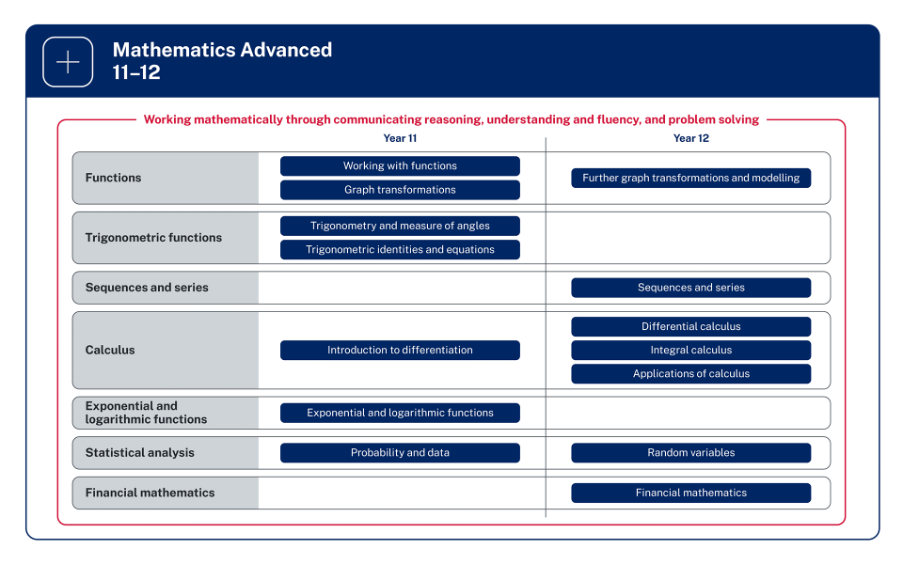
The Mathematics Advanced course is the beginning of a continuum to provide opportunities at progressively higher levels for students to acquire knowledge, skills and understanding in relation to concepts within the area of mathematics that have applications in an increasing number of contexts. These concepts and applications are appropriate to the students’ continued experience of mathematics as a coherent, interrelated, interesting and intrinsically valuable study that forms the basis for future learning. The concepts and techniques of differential and integral calculus form a strong basis of the courses, and are developed and utilised across the courses, through a range of applications and in increasing complexity.

PREREQUISITES AND COURSE REQUIREMENTS

The outcomes and content in the Stage 6 Mathematics Advanced syllabus are written with the assumption that students studying this course will have engaged with all core strands and many of the path strands in Stage 5. At ICS, this level of study aligns with the Pathway to Advanced course in Stage 5. Consequently, content in the NSW Mathematics K–10 syllabus up to and including this level is also implicit in this syllabus. In a number of cases where content from Stage 5 is included, it is in the context of review for clarity and completeness. Schools have the opportunity to review other areas of Stage 5 content as appropriate to meet the needs of students.

Students who are looking to pursue a mathematics-related career are encouraged to attempt the Mathematics Advanced course.

BENEFITS AND APPLICATIONS

The Mathematics Advanced course is focused on enabling students to appreciate that mathematics is a unique and powerful way of viewing the world to investigate patterns, order, generality and uncertainty. The course provides students with the opportunity to develop ways of thinking in which problems are explored through observation, reflection and reasoning.

The Mathematics Advanced course provides a basis for further studies in disciplines in which mathematics and the skills that constitute thinking mathematically have an important role. It is designed for those students whose future pathways may involve mathematics and its applications in a range of disciplines at the tertiary level.

Mathematics Extension 1

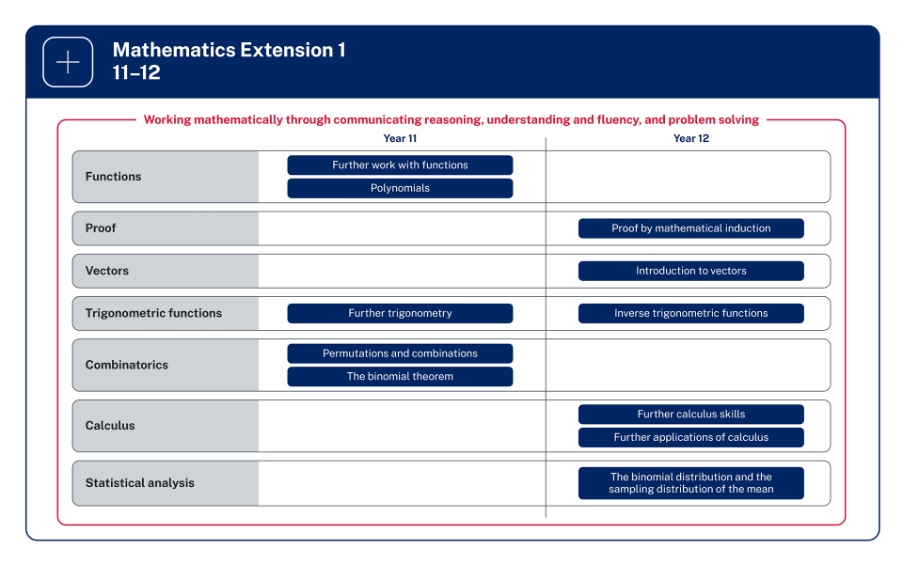
Mathematics Extension 1 is a 1-unit course that is part of a continuum to provide opportunities at progressively higher levels for students to acquire knowledge, skills and understanding in relation to concepts within the area of mathematics that have applications in an increasing number of contexts. These concepts and applications are appropriate to the students’ continued experience of mathematics as a coherent, interrelated, interesting and intrinsically valuable study that forms the basis for future learning. The introductory concepts and techniques of differential and integral calculus form a strong basis of the courses, and are developed and utilised across the courses, through a range of applications.

PREREQUISITES AND COURSE REQUIREMENTS

The outcomes and content in the Stage 6 Mathematics Extension 1 course are written with the assumption that students studying this course will have engaged with all core and path strands in Stage 5.

BENEFITS AND APPLICATIONS

Mathematics Extension 1 is focused on enabling students to develop a thorough understanding of, and competence in, further aspects of mathematics. The course provides opportunities to develop rigorous mathematical arguments and proofs, and to use mathematical models more extensively. Students of Mathematics Extension 1 will be able to develop an appreciation of the interconnected nature of mathematics, its beauty and its functionality.

Mathematics Extension 1 provides a basis for progression to further study in mathematics or related disciplines in which mathematics has a vital role at a tertiary level. An understanding and exploration of Mathematics Extension 1 is also advantageous for further studies in such areas as science, engineering, finance and economics.

Mathematics Extension 2

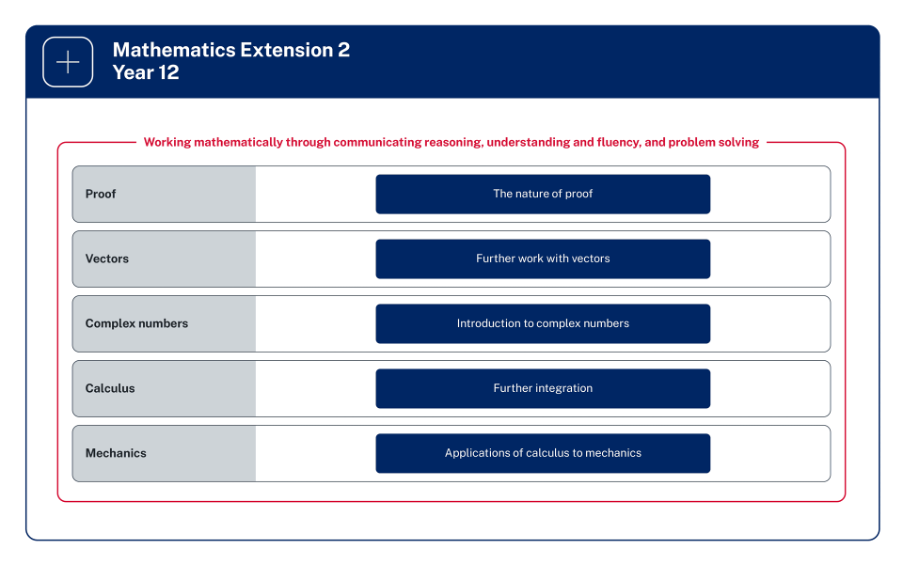
Mathematics Extension 2 is a 1-unit course which is the culmination of a continuum to provide opportunities at progressively higher levels for students to acquire knowledge, skills and understanding in relation to concepts within the area of mathematics that have applications in an increasing number of contexts. These concepts and applications are appropriate to the students’ continued experience of mathematics as a coherent, interrelated, interesting and intrinsically valuable study that forms the basis for future learning. The introductory concepts and techniques of differential and integral calculus form a strong basis of the courses, and are developed and utilised across the courses, through a range of applications.

Mathematics Extension 2 is only offered in Year 12.

PREREQUISITES AND COURSE REQUIREMENTS

The course is designed for students with a special interest in Mathematics who have shown they possess an aptitude for the subject and have been successful in Mathematics Extension 1 during the preliminary year.

BENEFITS AND APPLICATION

Mathematics Extension 2 provides students with the opportunity to develop strong mathematical manipulation skills and a deep understanding of the fundamental ideas of algebra and calculus. Students strengthen their appreciation of mathematics as an activity with its own intrinsic value, involving invention, intuition and exploration. Mathematics Extension 2 extends students’ conceptual knowledge and understanding through the exploration of new areas of mathematics not seen in Mathematics Advanced and Mathematics Extension 1.

Mathematics Extension 2 provides a basis for a wide range of applications of mathematics as well as a strong foundation for further study of the subject at tertiary level.

Creative & Performing Arts (CAPA) Department

Dance

The Dance 11–12 syllabus provides students with the opportunity to perform, choreograph, research and analyse dance works that communicate and inform life experiences through abstract symbolic movement.

PREREQUISITES AND COURSE REQUIREMENTS

Prerequisites: Nil

What students learn:

Students develop the knowledge, understanding and skills to communicate ideas through performance, choreography and appreciation as the central artistic practices of Dance.

  • Through performance, students adapt and apply dance technique to perform dance works in different styles and contexts.
  • Through choreography, students create abstract symbolic movements in response to a context and a stimulus that are structured and refined to communicate their intent.
  • Through appreciation, students explore dance as an art form, and in cultural, social and personal contexts and they analyse and make judgements about dance works.

PRELIMINARY COURSE

The Year 11 Dance course comprises a study of 120 indicative hours across three focus areas.

  • Performance
  • Choreography
  • Appreciation

Students are required to study an Aboriginal and/or Torres Strait Islander dance work and a work by an international choreographer.

HSC COURSE

The Year 12 Dance course comprises a study of 120 indicative hours across three focus areas.

  • Performance
  • Choreography
  • Appreciation

Performance

Students will perform two contrasting solo dance works demonstrating the context and synthesis of the components of performance and communication of the intent.

The two solo dance works must be contrasting in the use of components of performance.

The dance works are to be developed from classwork and during class time.

Choreography

Students will choreograph a solo dance work to be performed by themselves or by another student from the school. They will draw on their research of a prescribed practitioner from the HSC Dance prescriptions as stimulus for the choreographed dance work.

Simple props and costumes that are integral to the choreography are permitted.

Appreciation

Students will study the prescribed dance work from the HSC Dance prescriptions, focusing on an analysis of  context and the components of appreciation.

Students will research ONE prescribed practitioner from the HSC Dance prescriptions, their context and body of work.

The HSC Dance prescriptions 2028–2031 provide essential information for HSC study for the Dance 11–12 syllabus.

Some students with disability may require adjustments to engage in performance, choreography and/or appreciation.

BENEFITS AND APPLICATION

Dance 11–12 aims for students to acquire the knowledge and skills to communicate ideas through the abstract symbolic language of dance performance, choreography and appreciation. The study of Dance will provide students with intellectual, physical, creative, social and emotional development. It will contribute to their aesthetic, artistic and cultural education.

This course is accessible for various types of students, including those who:

  • enjoy dance and would like to expand their knowledge and skill
  • would like to develop their critical and creative ability in dance performance and composition
  • would like to develop a deep understanding of differing perspectives, culture and society through dance experiences
  • enhance personal and social skills by working collaboratively with others in dance
  • would like to follow a career in fields which require teamwork, self-discipline, leadership, effective verbal and non-verbal communication and good people skills
  • would like to develop knowledge and skills that form a valuable foundation for a range of courses at university and other tertiary institutions.

Drama

The Drama 11–12 syllabus (a new course for 2027) provides opportunities for students to become informed dramatic practitioners through the central and interrelated practices of making, performing and critically reflecting. Students explore dramatic contexts, elements and processes, building their knowledge of dramatic conventions, forms and styles to extend and enrich their own creative and critical works.

PREREQUISITES AND COURSE REQUIREMENTS

Previous experience in Drama is desirable but not essential. Drama is a subject that requires the ability to collaborate with others in a team context. It also requires self-discipline, and the ability to manage time and a task, particularly with the preparation of the Individual Project. These factors should be considered when selecting Drama for the HSC.

What students learn

Students develop the knowledge, understanding and skills to communicate their ideas through the interrelated practices of drama: making, performing and critically reflecting.

  • Through making, students workshop and create ideas, images and stories through enquiry, research, embodiment and experimentation, shaping concepts with dramatic contexts, processes and elements.
  • Through performing, students refine skills and apply dramatic elements and conventions to stage and perform works to create experiences that communicate concepts and vision that engage audiences in different contexts.
  • Through critically reflecting, students analyse dramatic works and experiences through processes, contexts and elements to understand how creative intent and vision are shaped in their own works and the works of others.

PRELIMINARY COURSE

Topics include:

  • Forms and styles
  • Improvising and devising
  • Scripts in practice

HSC COURSE

Topics include:

  • Australian drama and theatre
  • Approaches to drama and theatre (Group Performance)
  • Individual project

Australian drama and theatre

Students explore how Australian practitioners use dramatic forms, styles and conventions to convey ideas and perspectives through the study of TWO prescribed Australian dramatic works.

Approaches to drama and theatre (Group Performance)

Students collaboratively devise ONE ensemble performance which draws on the approaches of ONE prescribed practitioner as inspiration.

Individual project

Students initiate, structure and shape an individual project in ONE of the following dramatic forms:

  • design (costume OR promotion OR set)
  • director’s folio
  • performance
  • scriptwriting
  • short film

Drama is created through the interrelated practices of making, performing and critically reflecting. In the Drama 11–12 Syllabus content of these interrelated practices is designed to be taught in an integrated program to support student learning and artistic development.

BENEFITS AND APPLICATION

The Performing Arts have always been a significant part of human activity because they enable us to interpret, understand, express and influence the concerns of people and their communities.

This course will develop numerous skills and dramatic dimensions ranging from the technical, vocational and recreational to the spiritual, creative and cultural.

It aims to develop skills useful for ministry and the vocational use of Drama. Therefore, it is an excellent course for various types of students, including those who:

  • enjoy going to the theatre and would like to expand their knowledge
  • would like to follow a career in fields which require teamwork, effective time and task management, good people skills and the ability to speak confidently to an audience.

Drama students often choose careers in:

  • events coordination
  • film and television
  • ministry and missions
  • performing arts
  • politics
  • psychology
  • public relations.

Music 1

The Music 1 11–12 syllabus (a new and updated course for 2027) provides students with the opportunity to perform, listen, analyse and respond, and create and compose music through diverse repertoire. Students develop knowledge of Music context and Music language to evaluate and interpret music, and develop their creative practice to perform, create, explore and shape musical ideas with expressive intent.

PREREQUISITES AND COURSE REQUIREMENTS

This course accommodates the widely differing needs and abilities of students, ranging from the broadly-based to the desire to specialise, by allowing flexibility in the topic choice and areas of study. It assumes no prior knowledge of musical notation beyond Stage 4 Music (or equivalent, which is a prerequisite); however, it is advisable for students to have previous experience on an instrument (or voice), and to be receiving individual lessons.

Exclusions: Music 2.

What students learn:

Through the study of Music 1 11–12, students develop aural skills and their understanding of Music context and Music language to build the knowledge, understanding and skills needed to engage with music, explore creative practice and communicate musical ideas across a diverse range of styles and traditions. Through Music 1, students:

  • perform repertoire with stylistic awareness, exploring different approaches and techniques to communicate expressive intent
  • listen to, analyse and respond to music from varied cultural, historical and social contexts to investigate how style, convention and context shape meaning
  • create and compose music by experimenting with varied approaches, technologies and media to generate and shape musical ideas with expressive intent and purpose

PRELIMINARY COURSE

The Year 11 Music 1 course comprises a study of 120 indicative hours across three focus areas:

  • Contexts of music
  • Creative practice
  • Music in focus

HSC COURSE

The Year 12 Music 1 course comprises a study of 120 indicative hours across three focus areas:

  • Music of the last 25 years (Australian focus)
  • Music across cultures, traditions and time
  • Music for screen, stage and story

Music across cultures, traditions and time

Students explore how music reflects and communicates cultural, historical and regional identities in ONE chosen context from the list below:

  • Music of a style
  • Music of a region
  • Music of a culture
  • Music of a tradition
  • Music of a religion
  • Music of a historical period

Music for screen, stage and story

Students explore how music serves a specific purpose within artistic, social or communicative contexts in ONE chosen style from the list below:

  • Music for visual media
  • Music for theatre
  • Music for dance
  • Music for entertainment
  • Music for ritual and ceremony
  • Music for communication and storytelling
  • Music context and Music language

The content of the Music 1 11–12 syllabus is based on students developing their understanding of Music context and Music language through the study of selected repertoire in each focus area. Music context and Music language is integrated as appropriate throughout each focus area across Year 11 and 12.

Music context relates to the knowledge of:

  • style
  • genre
  • conventions

Music language includes:

  • theoretical language, which underpins compositional devices, techniques and processes
  • compositional language, which includes the techniques, methods or tools used by composers and performers to construct, develop and shape musical ideas
  • notational language, which refers to symbols and signs used to represent or document music

Repertoire requirements

Engaging with repertoire is central to study of the Music 1 11–12 syllabus. Repertoire refers to a body of music and is not limited to a single piece of music. Well-chosen repertoire enables students to enhance their knowledge, understanding and experience of music. Across Year 11 and Year 12, the selection of repertoire must include:

  • music of Aboriginal and Torres Strait Islander peoples
  • music of contemporary popular styles
  • Western art music
  • jazz
  • music of global music culture
  • electronic music
  • a range of vocal, instrumental, solo and ensemble music

Composition log

Documenting ideas, reflections and refinements supports the development of students’ knowledge, understanding and skills as composers. They learn from their reflections on the development of their piece to gain insight into the composition process. In the Year 12 course, students are required to document the development of their composition including:

  • research, planning and structural directions
  • experimentation and reflection on a range of approaches to the creation of new musical ideas
  • the application of and resolution of creative risk
  • exploration, use and critical evaluation of compositional language to realise musical intent
  • the relationship between their compositional decisions and the audio submission

BENEFITS AND APPLICATION

This is an excellent course for various types of students, including those who:

  • enjoy music and/or singing for pleasure and would like to expand their knowledge and skill
  • would like to develop their creative ability in music performance and composition
  • would like to enhance their cultural appreciation by developing the ability to converse confidently about a range of musical styles and genres, and to critique them in an informed and distinctly Christian manner
  • would like to follow a career in fields which require teamwork, self-discipline, leadership, effective verbal and non-verbal communication and good people skills
  • would like to develop knowledge and skills that form a valuable foundation for a range of courses at university and other tertiary institutions
  • would like to play or sing in worship services or use music to minister to others

Visual Arts

Visual Arts involves students in the practices of art-making, art criticism and art history. Students develop their own artworks, culminating in a body of work in the HSC course that reflects students' knowledge and understanding of art-making practice and which demonstrates their ability to resolve a conceptually strong work. Students critically investigate artists, artworks, critics and art historians from Australia as well as those from other cultures, traditions and times. The Preliminary course is broad, while the HSC course provides for deeper independent investigations. While the course builds on Visual Arts courses in Stage 5, it also caters for students with only Stage 4 experience in Visual Arts.

PREREQUISITES AND COURSE REQUIREMENTS

The Preliminary course requires a broad investigation of ideas in art criticism and art history. Through structured units and interventions, students will produce:

  • artworks in at least two forms and the use of a process diary
  • a broad investigation of ideas in artmaking, art criticism and art history

In the HSC course, students work autonomously, with teacher support and guidance, to develop:

  • a body of work documented in a process diary
  • students will undertake a minimum of five Case Studies (4–10 hours each)
  • deeper and more complex investigations of ideas in art criticism and art history

PRELIMINARY COURSE

Focus areas include:

  • the nature of practice in art-making, art criticism and art history
  • the role and function of artists, artworks, the world and audiences in the art world
  • the different ways the visual arts may be interpreted and how students might develop their own informed points of view
  • nurturing students' development of meaning, focus and interest in their work
  • building understandings over time through various investigations and working in different forms.

HSC COURSE

Focus areas include:

  • nurturing students to develop their own informed points of view in increasingly more independent ways, using the frames
  • developing students’ personal practice of art-making, art criticism and knowledge of art history applied to selected areas of interest
  • helping students synthesise their understanding of the relationships between artist, artwork, the world and audiences within the art world
  • further development of meaning and focus in students’ work.

BENEFITS AND APPLICATION

This is an excellent course for various types of students, including those who:

  • enjoy creative and analytical thinking
  • would like to develop their creative and technical skills in the visual arts
  • are looking for a subject to balance their more academic pursuits by providing a form of stress relief through practical art-making
  • would like to develop the ability to converse confidently about art and culture
  • enjoy exploring history, culture and ideas
  • would like to follow a career in fields including graphic design, architecture, ministry and missions, teaching, animation, film-making, landscape design and many other creative fields.

Human Society & Its Environment (HSIE) Department

Ancient History

The Year 11 course is structured for students to investigate:

  • people, groups, events, institutions, societies and historical sites
  • archaeological and written evidence and the methods used by historians and archaeologists in case studies and in the study of ancient societies.

The course provides a background for students’ more specialised HSC studies.

In the Year 12 course, students use archaeological and written evidence to investigate a personality from the ancient world plus an ancient society, an historical period and carry out an historical investigation.

PREREQUISITES AND COURSE REQUIREMENTS

There are no prerequisites for this course, but students should enjoy reading history and must be prepared to read widely and think critically when evaluating historical evidence.

YEAR 11 COURSE

Part I: Investigating Ancient History

  • The Nature of Ancient History
  • Case Studies - Tutankhamun's Tomb and Masada

Part II: Features of Ancient Societies

  • Death and Funerary Customs in Egypt
  • Women in Ancient Greece and Rome

Part III: Historical Investigation

YEAR 12 COURSE

Part I: (Core) Cities of Vesuvius—Pompeii and Herculaneum

Part II: Ancient Societies—Athens in the time of Pericles

Part III: Historical Personalities—Agrippina the Younger

Part IV: Historical Periods—The Julio-Claudians 14-68 CE

Students in Year 12 can select one additional unit of study—History Extension 1.

BENEFITS AND APPLICATION

The study of ancient times helps us to understand the origins of democratic government and the rule of law which are fundamental aspects of Western society. Certain topics covered in Near Eastern and Roman history are useful as background to events in Roman times. Students should be able to appreciate God’s wisdom, purpose and planning when Jesus Christ was born into the comparatively ordered world of the Roman Empire, thus beginning a process by which Christianity spread eventually to the whole world. The skills learned such as research, evaluation and written expression are an excellent preparation for many university courses such as Law, Commerce, Journalism, Religion, Politics and the Arts.

Business Studies

This course is studied in the context of God who is the creator of all man’s wealth and resources.

Business Studies is not just for those who want to be small business owners or global entrepreneurs. Whatever occupation you end up in, Business Studies will be relevant and of value. Understanding how to manage teams, motivate staff, keep budgets, formulate strategic plans, navigate employment law, create promotional materials, and organise tasks are skills that are transferable and relevant to all workplaces.

Students investigate the role of local and global businesses. Students develop research and independent learning skills in addition to analytical and problem-solving competencies through their studies. Case studies are a feature of the course. These may include: QANTAS, Apple and McDonalds.

PREREQUISITES AND COURSE REQUIREMENTS

Business Studies has a close relationship to Commerce but is much wider in its business application. There are no prerequisites to the course and it is suitable for a wide range of students.

YEAR 11 COURSE

Topics include:

  • Nature of business
  • Business management
  • Business planning

YEAR 12 COURSE

Topics include:

  • Operations
  • Marketing
  • Finance
  • Human resources

BENEFITS AND APPLICATION

The aim of the course is to give students an insight into the workings of the business world. This may raise many moral implications that are important for Christians to face and resolve.

The course is excellent preparation for employment in the business world, as it provides a good understanding of the processes involved. It is also a useful subject as preparation for a Commerce or Economics degree at university.

Economics

Economics provides an understanding for students about many aspects of the economy and its operation that are frequently reported in the media. It investigates issues such as why unemployment or exchange rates change and how these changes will impact on individuals in society.

Economics develops students’ knowledge and understanding of the operation of the global and Australian economy. It develops the analytical, problem-solving and communication skills of students. There is a strong emphasis on the problems and issues in a contemporary Australian economic context within the course.

Some economic issues investigated are:

  • What influences our choices?
  • Why do interest rates rise and fall?
  • What determines the price of the Australian dollar? What is the impact of appreciation and depreciation?
  • How should government spend funds? Is a deficit bad? How do budgets work?
  • What contributes to unemployment? What are the strategies to lower the rate?
  • Imports, exports and finance flows
  • Income inequality
  • Quality of life between countries.

PREREQUISITES AND COURSE REQUIREMENTS

There are no prerequisites to the study of Economics, though Commerce students will find some areas familiar.

PRELIMINARY COURSE

Topics include:

  • Introduction to Economics
  • Markets
  • Household and Business Sector
  • Financial Sector
  • Government Sector
  • International Sector

HSC COURSE

Topics include:

  • Economic Issues in the Australian Economy
  • Economic Management of the Australian Economy
  • Australia and the Global Economy

BENEFITS AND APPLICATION

The aim of the Economics course is to develop each student’s ability to view economic events and make decisions in light of God’s character and his purposes, and respond in a way which pleases him. It is about making decisions and understanding the implications of decisions by individuals, groups and governments.

The course is designed to be challenging and beneficial to all students irrespective of their career aspirations. Careers where training in Economics is especially useful include policy work, management, finance, trading, accountancy, law, sales, advertising, statistics, banking, public service and teaching.

Geography

The aim of Geography Stage 6 is to enable students to develop the ability to recognise and understand environmental change and the interactions which take place in our world. Students investigate the ecological dimension, considering how humans interact with environments, and the spatial dimension, exploring where things are, why they are there and how people interact differently with environments in different places. Stage 6 Geography allows students to perceive the world in a variety of ways and helps them make sense of a complex and changing world.

PREREQUISITES AND COURSE REQUIREMENTS

There are no prerequisites for the study of Geography, other than an interest in the world God has created for us, and its people.

The Stage 6 course requires students to conduct fieldwork as part of their studies. The Preliminary course involves a geographical investigation which allows students to select a local issue and carry out an investigation through fieldwork.

PRELIMINARY COURSE

Topics include:

  • Earth's Natural Systems
  • People, patterns and processes
  • Human environment interactions
  • Geographical investigation
  • Geographical tools and skills.

HSC COURSE

Topics include:

  • Global sustainability
  • Rural and urban places
  • Ecosystems and global biodiversity
  • Geographical tools and skills.

BENEFITS AND APPLICATION

Geography provides knowledge of the earth and helps students reach a deeper understanding of the variable character of life on our planet. Students of Geography develop skills and understandings transferable and applicable to the world of work as well as preparing them for active participation as informed citizens. The study of Geography forms a valuable foundation for a range of courses at university and other tertiary institutions.

History Extension

There is no Year 11 course of History Extension—it is a one-unit Year 12 course only.

History Extension is designed to enable students to build on the outcomes of the Stage 6 Ancient and Modern History courses in relation to historiography, historical inquiry and communication.

The course uses specific historical investigations to reflect on the nature of history and how and why approaches and interpretations change over time.

PREREQUISITES AND COURSE REQUIREMENTS

Students must have completed a Preliminary course in either Ancient or Modern History.

Students must be attempting the HSC course in either Ancient or Modern History concurrently with their study of History Extension.

HSC COURSE

Part I: Constructing History

Semester 1—Constructing History - Key Questions (analysing various historians and a variety of definitions and viewpoints on history)

Semester 2—Constructing History - Case Study - Early Christianity

Part II: History Project

The history project provides the opportunity for students to design and conduct an investigation in an area of changing historical interpretation. This is a major project undertaken over the course of the year.

It requires students to:

  • design their own question
  • submit a proposal
  • undertake thorough research
  • compose an essay with a synopsis
  • include an annotated bibliography
  • keep a process log of the whole project.

BENEFITS AND APPLICATION

This course provides students with knowledge, understanding and skills that form a valuable foundation for a range of courses at university and other tertiary institutions. These include Law, Commerce, Journalism, Religion, Politics and the Arts.

The Case Study—Early Christianity—allows young Christians to develop a firm understanding of the historical reliability of the New Testament accounts of the growth of the early church.

Modern History

The Year 11 course is designed to provide students with opportunities to investigate individuals, groups, events, institutions, societies and ideas in a range of historical contexts as a background for their more specialised HSC studies.

The Year 12 course is designed for students to investigate national and international forces for change and continuity in the twentieth century.

PREREQUISITES AND COURSE REQUIREMENTS

There are no prerequisities for this course, but success in the Modern History course requires an interest in the subject matter, a commitment to reading, research and study, and skills in essay writing. All of these will be encouraged throughout the course.

YEAR 11 COURSE

Part I: Investigating Modern History

  • The nature of modern history - contemporary methods and issues involved in the investigation of modern history
  • Case Studies—The Decline and Fall of the Romanov Dynasty and the Origins of the Arab-Israeli Conflict

Part II: Historical Investigation—Research task and essay on an area of Modern History of the student’s own choosing

Part III: The Shaping of the Modern World—The First World War

YEAR 12 COURSE

Part I: Core study - Democracy and dictatorship 1919–1939 (including a study of Nazi Germany)

Part II: National Study—Russia and the Soviet Union 1917–1941

Part III: Peace and Conflict—Arab-Israeli Conflict 1948–2000

Part IV: Change in the Modern World—The Changing World Order 1989–2016

Students in Year 12 can also select one additional unit of study—History Extension 1.

BENEFITS AND APPLICATION

Students develop an understanding of the forces that have shaped the modern world, and are better able to formulate arguments based on an understanding of historical concepts. They develop a keen interest in the contemporary world.

The skills learned—research, evaluation and written expression—are an excellent preparation for many university courses such as Law, Commerce, Journalism, Religion, Politics, and the Arts.

This is a particularly relevant course for young Christians wishing to understand current world trends and events, or to be thoughtful to the forces which are operating—for good or evil—in today’s world. It may be relevant for those who seek to discern God’s purposes for themselves and their world amidst the problems of modern times.

Society and Culture

The central goal of Society and Culture Stage 6 is the development of social and cultural literacy and a clear understanding of the interaction of persons, societies, cultures, environments and time. The influence of other aspects of societies and cultures – including power, authority, identity, gender, technologies and globalisation – is also central to the course.

PREREQUISITES AND COURSE REQUIREMENTS

There are no prerequisites for Society & Culture.

YEAR 11 COURSE

  • The Social and Cultural World
  • Personal and Social Identity
  • Intercultural Communication

YEAR 12 COURSE

  • Personal Interest Project (see details below)
  • Social and Cultural Continuity and Change
  • Depth studies

TWO depth studies to be chosen from the following:

  • Popular Culture
  • Belief Systems and Ideologies
  • Social Inclusion and Exclusion
  • Social Conformity and Nonconformity

Skills

Students are provided with essential concepts, skills, competencies and knowledge to encourage a process of independent thinking that can be used to explain patterns of behaviour, solve problems, and engage in and actively contribute to all levels of society. Society and Culture is a conceptually based course that promotes students' awareness of the cultural continuities and changes within societies and cultures. It provides them with skills to critically analyse social theories and complementary and contrasting viewpoints about people, societies and cultures. Society and Culture promotes an awareness of individuals, groups and institutions and facilitates intercultural understanding and communication.

Personal Interest Project:

A third of Year 12 course time is devoted to a 'Personal Interest Project' which is externally marked and comprises 40% of the HSC mark. The remaining 60% are from a traditional HSC examination.

Further information on the 'Personal Interest Project' can be found here.

BENEFITS AND APPLICATION

Society and Culture draws on cross-disciplinary concepts and social research methods from anthropology, communication, cultural and media studies, philosophy, social psychology, and sociology. Society and Culture has direct relevance to the immediate needs of students and to their future lives by enabling them to develop understanding of themselves, their own society and culture, and the societies and cultures of others.

Languages other than English (LOTE) Department

French Beginners

French Beginners provides intensive and enjoyable exposure to the French language. It is designed for students who desire to begin their study of a language in Senior School and who have little or no previous experience with learning this language.

The course aims to give students enough language to be able to "get by", for example, whilst travelling. However, motivated students are able to extend themselves, and can develop their language skills as far beyond this as they desire.

PREREQUISITES AND COURSE REQUIREMENTS

To access this course students must have done fewer than or equal to 100 hours—that is, one year or less of French in high school, either in Stage 4 or 5.

PRELIMINARY AND HSC COURSES

The French Beginners course aims to enable students to develop:

  • skills in effective communication
  • knowledge of the nature of language
  • understanding of the interdependence of language and culture.

Students will learn to communicate about:

  • their personal world (home, family, friends, future plans)
  • French-speaking communities (how these things are experienced and expressed in French speaking communities around the world).

The HSC examination consists of two exams in which all four skills (reading, writing, speaking and listening) are tested.

The oral exam consists of a five-minute conversation between the student and examiner on a range of topics and allows the student to demonstrate the breadth of their ability. This exam is completed prior to the HSC, usually in August.

The written exam assesses listening, reading and writing skills.

BENEFITS AND APPLICATION

French is one of the fastest growing languages in the world. It is spoken across every continent (including Australasia) and is an official language of countries in Europe, Canada, North America, Africa, the Middle East and in the Indian and Pacific Ocean regions. Research suggests that by 2050, French will be spoken by 750 million people.

Language learning has been shown to:

  • facilitate intellectual development beyond the language classroom
  • enhance creativity
  • develop more refined and sophisticated skills in analysis, negotiation and problem-solving
  • improve literacy ability
  • enhance students’ communication skills and confidence
  • improve cross-cultural understanding and general knowledge
  • assist students in developing knowledge, understanding and skills for successful participation in the dynamic, globalised world of the 21st century
  • nurture appreciation of God’s creation, evident in the diversity of humanity
  • inspire and equip students to become people who share God’s concerns for foreigners and his desire for everyone to hear the wonderful news of the gospel.

French Beginners students often use their knowledge of French to:

  • pursue further study of French at tertiary level
  • participate in exchange programs
  • study linguistics and/or other languages
  • pursue international studies
  • travel or work in French-speaking countries
  • prepare for the mission field
  • work with refugees or aid organisations locally.

Japanese Beginners

This course equips students relatively new to the Japanese language, with communication skills in modern standard Japanese in both written and spoken forms. Students will learn both informal and formal levels of language. Hiragana and Katakana syllabaries and a prescribed number of Kanji (Chinese characters) will be also studied.

PREREQUISITES AND COURSE REQUIREMENTS

The Japanese Beginners Stage 6 course is a two-year course, which has been designed for students who wish to begin their study of Japanese at the senior secondary level. It is intended to cater only for students with no prior knowledge or experience of the Japanese language, either spoken or written, or whose experience is derived solely from, or is equivalent to, its study for 100 hours (1 year) or less in Stage 4 or Stage 5.

PRELIMINARY AND HSC COURSE AIM

The aim of the Japanese Beginners Stage 6 Syllabus is to enable students to develop:

  • skills in effective communication
  • knowledge of the nature of language
  • understanding of the interdependence of language and culture.

COURSE DESCRIPTION

The Preliminary Course has outcomes as its organisational focus. Topics provide contexts in which students develop their communication skills in Japanese and their knowledge and understanding of language and culture.

In the HSC course students will extend and refine their communication skills in Japanese in contexts defined by topics, and will gain a deeper knowledge and understanding of language and culture.

MAIN TOPICS COVERED

The prescribed topics should be studied from two interdependent perspectives:

  • the personal world
  • the Japanese-speaking communities.

The two perspectives will enable students to develop knowledge and understanding of and skills in the Japanese language, linked to cultural values, attitudes, and practices.

BENEFITS AND APPLICATION

Learning a language leads to lifelong personal, educational, and vocational benefits. Most importantly, it helps students to appreciate the diversity of God's world, enabling them to understand others and value all people as God's children. This course is designed to equip students with conversational Japanese skills and cultural understanding, and a deeper awareness of different values and attitudes within the wider Australian community and beyond.

Japanese has been identified as one of the priority languages in the Asia-Pacific region to be taught in Australian schools. This is in recognition of the fact that Japan is Australia's leading trading partner and that there are significant cultural ties between Australia and Japan. Studying Japanese may give students wishing to pursue careers in international commerce and in tourism a significant advantage.

Illawarra Christian School has a language and cultural exchange partnership with a school in Japan, which provides students the opportunity to interact with Japanese students as they visit our school and our region. Students will also be expected to participate in outings and excursions to facilitate cultural and linguistic experiences.

Japanese Continuers

This course equips students with communication skills in modern standard Japanese in both written and spoken forms. Students will learn both informal and formal levels of language. Hiragana and Katakana syllabaries and a prescribed number of Kanji (Chinese characters) will be also studied.

PREREQUISITES AND COURSE REQUIREMENTS

The Japanese Continuers Stage 6 Syllabus is designed for students who, typically, will have studied Japanese for over 100 hours in either Stage 4 or 5 and who will have studied between 400–500 hours by the completion of Stage 6. Some students with less formal experience will also be able to meet the requirements of the syllabus successfully.

PRELIMINARY AND HSC COURSE AIM

This course focuses not only on written and spoken Japanese, but also on the cultural aspects of Japanese society. Students will learn to converse about a range of topics so as to enable effective communication with Japanese people. Students will explore aspects of modern and traditional Japanese society, and learn to engage in culturally appropriate ways.

COURSE DESCRIPTION

The Preliminary and HSC courses have, as their organisational structure, particular themes and associated topics. Students’ skills in, and knowledge of, Japanese will be developed through tasks associated with a range of texts and text types, which reflect the themes and topics. Students will also gain an insight into the culture and language of Japanese communities through the study of a range of texts.

MAIN TOPICS COVERED

Themes:

  • the individual
  • the Japanese-speaking communities
  • the changing world.

Students' language skills are developed through tasks such as:

  • conversation
  • responding to an aural stimulus
  • responding to a variety of written material
  • writing for a variety of purposes.

BENEFITS AND APPLICATION

Learning a language leads to lifelong personal, educational and vocational benefits. Most importantly, it helps students to appreciate the diversity of God's world, enabling them to understand others and value all people as God's children. This course is designed to equip students with conversational Japanese skills and cultural understanding, and a deeper awareness of different values and attitudes within the wider Australian community and beyond.

Japanese has been identified as one of the priority languages in the Asia-Pacific region to be taught in Australian schools. This is in recognition of the fact that Japan is Australia's leading trading partner and that there are significant cultural ties between Australia and Japan. Studying Japanese may give students wishing to pursue careers in international commerce and in tourism a significant advantage.

Illawarra Christian School has a language and cultural exchange partnership with a school in Japan, which provides students the opportunity to interact with Japanese students as they visit our school and our region. Students will also be expected to participate in outings and excursions to facilitate cultural and linguistic experiences.

Japanese Extension

There is no Year 11 course of Japanese Extension—it is a one-unit Year 12 course only.

The organisational focus of the Japanese Extension course is the theme: the individual and contemporary society. A number of issues that exemplify aspects of the theme are prescribed for study. Students engage with the issues through the study of a prescribed text and related texts.

PREREQUISITES AND COURSE REQUIREMENTS

Students must have studied Japanese Continuers in Year 11 and concurrently in Year 12 to be eligible to undertake the Japanese Extension course.

HSC COURSE

Connectedness

  • belonging
  • parenthood
  • child/parent relationships

Journeys

  • making choices
  • overcoming adversity
  • self reflection

Diversity of values

  • attitudes to work
  • concept of family
  • finding happiness

BENEFITS AND APPLICATION

Students extend their ability to use and appreciate Japanese as a medium for communication and creative thought and expression.

Personal Development, Health & Physical Education (PDHPE) Department

Community and Family Studies (CAFS)

Contemporary society is characterised by rapid social and technological change, cultural diversity, conflicting values and competitive pressure. Yet in the midst of this we have one solid truth to which we cling as Christians—the unswerving faithfulness and unchanging character of our God. It is from the truth of the Scriptures that we critique and examine many of the secular ideas that underpin the concept of family and community, to encourage our students to come to a deeper understanding of the vital importance of the role of both the individual and the family unit, in weaving the very fabric of our  society.

Community & Family Studies is an interdisciplinary course which draws upon family studies, sociology, developmental psychology and students’ life experience, to give a detailed study of human behaviour and societal interaction. The course has a strong focus on effective resource management that enables a person to function effectively in their everyday life, whilst acknowledging at all times that Jesus calls us to live in fellowship and harmony with one another and with him.

The syllabus focuses the Preliminary course on the individual and their interactions with personal groups, family and community. The HSC course builds upon this by examining how the wellbeing of individuals, families and communities is affected by broader societal influences including sociocultural, economic and political factors.

PREREQUISITES AND COURSE REQUIREMENTS

There are no prerequisites for the study of Community & Family Studies.

PRELIMINARY COURSE

Topics include:

  • Resource Management—Basic concepts of resource management.
  • Individuals and Groups—The individual’s roles, relationships and tasks within and between groups.
  • Families and Communities—Family structures and functions, and the interaction between family and community.

HSC COURSE

Topics include:

  • Research Methodology—Research methodology and skills culminating in the production of an Independent Research Project.
  • Groups in Context—The characteristics and needs of specific community groups.
  • Parenting and Caring—Issues facing individuals and groups who adopt roles of parenting and caring in contemporary society.
  • One elective from the topics: Family and Societal Interactions / Social Impact of Technology / Individuals and Work.

BENEFITS AND APPLICATION

The course will assist in preparing students for a range of vocational options. Many of our students choose to work in volunteer and paid capacities in fields that focus on children and community development, including childcare, Sunday school programs, education, social work and welfare. Offering secondary students the opportunity to investigate how family and community groups function from a Christian perspective lays a sound foundation for this important work. Community & Family Studies provides opportunities for students to explore and form positive attitudes about themselves and others; to develop an understanding of their relationships within their families and other groups; to learn to work cooperatively and to appreciate the importance of effective communication.

Health and Movement Science (HMS)

Health and Movement Science is a new course that commenced in 2025, replacing the senior PDHPE course. This course is designed to provide students with the opportunity to develop and apply their understanding and knowledge of health and movement skills. This will be done through taking a strengths-based approach and building health literacy and critical inquiry skills.

PREREQUISITES AND COURSE REQUIREMENTS

An interest in health, sport, physical activity and a healthy lifestyle is beneficial, however the level of physical skill is not relevant. Students are involved in learning about and practising ways of maintaining active, healthy lifestyles and improving their health status and the health status of Australia. It is also concerned with social and scientific understandings about enhancing movement potential.

There are no formal prerequisites for this course.

PRELIMINARY COURSE

  • Health for individuals and communities
  • The body and mind in motion

Collaborative investigation - The Collaborative Investigation provides opportunities for students to develop knowledge and skills to support their own and others' health and movement. It allows students to manage their own learning and to become flexible, critical thinkers, problem-solvers and decision-makers.

Depth studies (minimum of two) - 20 hours of course time will be dedicated to depth studies, enabling students to explore specific aspects of the course that pique their interest in greater detail.

HSC COURSE

  • Health in an Australian and global context
  • Training for improved performance

Depth studies (minimum of two) - 30 hours of course time will be dedicated to depth studies, enabling students to explore specific aspects of the course that pique their interest in greater detail.

BENEFITS AND APPLICATION

Health and Movement Science provides a direct link with study and vocational pathways in health and physical fitness. This includes vocations such as Sport Science, Physiotherapy, Education, Nursing, Paramedicine, Occupational Therapy, Medicine, Sports Management and Administration, Fitness, Personal Training, and Dietetics. It also encourages personal growth, the enhancement of wellbeing and the development of the individual's capacity to take a productive role in society.

Sport, Lifestyle and Recreation Studies

Students will learn about the importance of a healthy and active lifestyle and recognise the need to be responsible and informed decision-makers.

This course enables students to further develop their understanding of and competence in a range of sport and recreational pursuits. They are encouraged to establish a lifelong commitment to being physically active and to achieving movement potential.

PREREQUISITES AND COURSE REQUIREMENTS

This course caters for a wide range of student needs. It can assist students in developing:

  • the qualities of a discerning consumer and an intelligent critic of physical activity and sport
  • high levels of performance skill in particular sports
  • the capacity to adopt administrative roles in community sport and recreation
  • the skills of coach, trainer, first aid officer, referee and fitness leader. In the context of this course it may be possible for students to acquire recognised qualifications in these areas.

There are no formal prerequisites for this course.

SPECIAL NOTICE

There is no external examination (delivered by NESA) for SLR. Assessment is school-based and teachers award an assessment mark using the Performance Descriptions for reporting achievement in HSC Board Endorsed Courses.

SLR counts towards the Higher School Certificate and appears on the student's Record of Achievement. However, SLR does not count in the calculation of the Australian Tertiary Admission Rank (ATAR).

COURSE STRUCTURE

The Sport, Lifestyle and Recreation Course comprises 15 optional modules, not all may be studied and there is no prescribed order of study. Modules include Aquatics, Athletics, Dance, First Aid and Sports Injuries, Fitness, Games and Sports Applications I, Games and Sports Applications II, Gymnastics, Healthy Lifestyle, Individual Games and Sports Applications, Outdoor Recreation, Resistance Training, Social Perspectives of Games and Sports, Sports Administration, Sports Coaching and Training.

BENEFITS AND APPLICATION

SLR provides a direct link with study and vocational pathways in the areas of recreational, sports management, coaching, movement and health sciences. It also encourages personal growth, the enhancement of wellbeing and the development of the individual’s capacity to take a proactive role in maintaining their own health and fitness as well as that of others in the community.

Science Department

Biology

Biology is the study of living things. Students commencing Year 11 Biology in 2027 will have the opportunity to study a new syllabus which will be examined in the HSC for the first time in 2028.

The new syllabus presents students with a diverse range of topics from across the biological fields including cell biology, microbiology, ecology, evolutionary development, disease (pathology), biodiversity and cutting-edge biotechnology. We learn about everything from single-celled life up to multicellular plants and animals. There is something for everybody in Biology.

PREREQUISITES AND COURSE REQUIREMENTS

There are no prerequisites. However, success will come from having a genuine interest in the subject matter as well as a commitment to the development of language and written communication in order to explain concepts with accuracy, detail and precision.

Biology has one of the highest candidatures in the HSC and is accessible to students with a wide range of academic skills and abilities. However, it is recognised as a content-heavy subject so it is advised that students have demonstrated at least a C+ level of achievement in Stage 5 Science before embarking on this course.

YEAR 11 COURSE

Three focus areas each of approximately the same length.

  1. Cells as the Basis of Life - how cells function as the fundamental unit of living organisms
  2. Cells to Systems -how cells, tissues and systems contribute to complex multicellular organisms
  3. Evolution and ecosystems - the relationships between organisms and their environment using the theory evolution by natural selection

YEAR 12 COURSE

Focus areas are each approximately the same length and include:

  1. Heredity - analyses the role of DNA in the inheritance of traits and protein synthesis
  2. Diseases - causes and effects of infectious and non-infectious diseases, as well as strategies for prevention
  3. Biodiversity - analyses changes in ecosystems and strategies for conservation
  4. Biotechnology - uses of biotech in medicine, agriculture and biodiversity conservation

Skills: Embedded throughout both years of Biology is the development of important skills including questioning, conducting first-hand and secondary-source investigations to locate and assess reliable sources of information, problem-solving and communication.

BENEFITS AND APPLICATION

Highly recommended for students considering science-based studies at tertiary level, especially:

  • health (medicine, nursing, paramedicine)
  • agriculture
  • environment
  • biomedical engineering

Chemistry

Chemistry is the study of matter—the fabric of creation. It focuses on investigating the physical and chemical properties of substances, chemical reactions and processes and the interaction of energy and matter. Students will study natural and made substances; their structures, changes and environmental importance. The history and philosophy of science as it relates to Chemistry will also be investigated, how current understanding of chemistry is being developed and the application of chemistry in the contexts of technology, society and the environment.

PREREQUISITES AND COURSE REQUIREMENTS

There are no official prerequisites for studying Chemistry, but it is strongly recommended that students have a substantial achievement level based on the Stage 5 Science course performance descriptors (e.g. A or B grade). Year 11 Chemistry builds on and deepens students' understanding of concepts introduced in Year 10, so a solid foundation in these is of significant benefit.

Sound problem-solving and communication skills are an advantage for the potential Chemistry student. Mathemetical aptitude especially in algebra, substitution, and rearranging equations is a core skill for chemistry. Chemistry is strongly recommended as a prerequisite for study in science-based careers at tertiary level. Chemistry is a challenging subject, and hard work and commitment are necessary for success.

Practical experiences will occupy at least 35 hours in the both the Year 11 and Year 12 course.

YEAR 11 COURSE

Each module is approximately the same length (30 hours of course time):

  1. Properties and Structures of Matter - This module explores the fundamental properties and structures of matter, including atomic theory, the Periodic Table, and chemical bonding.
  2. Introduction to Qualitative Chemistry - This module introduces qualitative analysis techniques to identify and understand the composition of substances through chemical reactions and observations.
  3. Reactive Chemistry - This module examines the principles of chemical reactions, including reaction types, stoichiometry, and energy changes in reactions.
  4. Drivers of Reaction - This module investigates the factors that influence the rate and extent of chemical reactions, such as temperature, concentration, and catalysts.

YEAR 12 COURSE

Each module is approximately the same length (30 hours of course time):

  1. Equilibrium and Acid Reactions - This module focuses on chemical equilibrium and the behaviour of acids and bases, including Le Chatelier's principle and pH calculations.
  2. Acid/base Reactions - This module delves deeper into acid/base reactions, exploring titrations, buffer solutions, and their applications in various contexts.
  3. Organic Chemistry - This module covers the structure, properties, and reactions of organic compounds, incdluding hydrocarbons, alcohols, and polymers.
  4. Applying Chemical Ideas - This module applies chemical concepts to real-world scenarios, emphasising analytical techniques, spectroscopy, and the role of chemistry in industry and the environment.

Skills: Embedded throughout both years of Chemistry is the development of important skills including questioning, laboratory investigation, secondary investigations to locate and assess reliable sources of information, problem-solving and communication.

Depth study: 15 hours of course time will be allocated each year to depth studies , which are investigations that allow students to delve deeper into an aspect of the course.

BENEFITS AND APPLICATION

Chemistry helps students grow in their knowledge of God as they come to understand more of the workings of creation. It equips students for works of service in medical, industrial, technological, agricultural and environmental fields. It is also useful when trying to understand the properties and behaviours of both natural and human-made products.

Physics

Physics is the study of matter, energy, and the relationship between them. Students commencing Year 11 Physics in 2027 will have the opportunity to study a new syllabus which will be examined in the HSC for the first time in 2028.

The new syllabus encourages students to explore a diverse range of topics from across the physics fields of mechanics, waves, electromagnetism, the nature of light and the cosmos. Our study extends from the very small like quantum particles, to the very large like galaxies.

PREREQUISITES AND COURSE REQUIREMENTS

There are no official prerequisites for the study of Physics. However, it is recommended that only students considering Mathematics Advanced in Year 11 consider Physics, due to the mathematical skills required to understand and enjoy the course. Students considering Physics should also be committed to developing their written communication skills in order to explain the relationships between concepts, in tandem with the development of their calculation skills.

YEAR 11 COURSE

  • Focus Area 1: Fundamentals of mechanics - This focus area is 50 indicative hours. In it we analyse motion and events using scientific laws and models.
  • Focus Area 2: Waves - This focus area is 35 indicative hours. In it we explain the properties of behaviours of waves.
  • Focus Area 3: Electricity and magnetism - This focus area is 35 indicative hours. In it we explain the interaction of electric and magnetic fields.

YEAR 12 COURSE

  • Focus Area 4: Advanced mechanics - This focus area analyses circular and projectile motion.
  • Focus Area 5: Electromagnetism - This focus area explores the interaction between electric currents and magnetic fields.
  • Focus Area 6: Nature of light - This focus area analyses the properties of light and theories.
  • Focus Area 7: Matter, energy and the cosmos - This focus area analyses matter, its relationship with energy, and the roles of matter and energy in astronomical events.

Skills: Embedded throughout both years of Physics is the development of important skills including questioning, laboratory investigation, secondary investigations to locate and assess reliable sources of information, problem solving and communication.

BENEFITS AND APPLICATION

The study of Physics provides the foundational knowledge and skills required to support participation in a range of careers. It is a discipline that utilises innovative and creative thinking to address new challenges, such as sustainability, energy efficiency and the creation of new materials. Physics enables a student to understand in greater depth the majesty and power of God in Creation and opens vast opportunities for harnessing technology for beneficial and godly ends. The Physics student will be better equipped for works of service in medical, engineering, finance, transport, communication and industrial areas.

Science Extension

There is no Year 11 course of Science Extension—it is a one-unit Year 12 course only.

Science Extension is a course with a focus on the authentic application of scientific research skills to produce a Scientific Research Report generally acceptable for publication.

Students who have shown an achievement in, and/or aptitude for, any of the Stage 6 Science courses may express interest in studying Science Extension in Year 12.

PREREQUISITES AND COURSE REQUIREMENTS

Prerequisite courses for Science Extension Year 12 are one of, or a combination (up to 6 units of study) of, Biology, Chemistry, Earth and Environmental Science, Investigating Science or Physics in Year 11.

HSC COURSE

The Year 12 course consists of four modules:

  • Module 1 The Foundations of Scientific Thinking
  • Module 2 The Scientific Research Proposal
  • Module 3 The Data, Evidence and Decisions
  • Module 4 The Scientific Research Report

BENEFITS AND APPLICATION

Students propose and develop a research question, formulate a hypothesis and develop evidence-based responses to create a Scientific Research Report, which is supported and evidenced by a Scientific Research Portfolio. The four modules integrate the skills of Working Scientifically within the course content to form the framework for the Scientific Research Project.

Technological & Applied Sciences (TAS) Department

Design and Technology

Students are involved in the study of design processes, design theory and factors in relation to design, through the development of practical projects.

In the Preliminary course, students undertake at least two practical projects that focus on various aspects of the design process. In the HSC course, students undertake a Major Design Project in conjunction with a study of innovation and emerging technologies.

It is important to note that this is NOT a Wood Technology class.

PREREQUISITES AND COURSE REQUIREMENTS

There are no prerequisites for this subject. Students in Year 12 particularly need be self-motivated, organised and show initiative to complete their Major Design Projects.

In the Preliminary course, students must participate in hands-on practical activities. In the HSC course, the comprehensive study of designing and producing that were studied in the Preliminary course are synthesised and applied. This culminates in the development and realisation of a Major Design Project and the presentation of a case study.

PRELIMINARY COURSE

This course covers designing and producing, including the study of:

  • tools and techniques
  • manipulation of materials
  • manufacturing and production
  • design processes
  • evaluation
  • creativity
  • collaborative design
  • communication
  • computer-based technologies
  • safety.

HSC COURSE

This course involves the study of designing and producing, including a Major Design Project. The project folio includes a project proposal and management, project development and realisation, and project evaluation. Other topics covered include:

  • innovation and emerging technologies, including a case study of innovation
  • environmental issues
  • research, analysis and marketing.

BENEFITS AND APPLICATION

The students are exposed to many industrial and technological applications and gain valuable knowledge and experience as a result. They are able to develop the many gifts that God has given them to be of service to others. As students will develop and implement skills in research, planning, time management and documentation, it will provide a solid foundation for future career options in a variety of fields.

Engineering Studies

The Engineering Studies Stage 6 syllabus is directed towards the development and application of mathematical, scientific and technological skills and their integration with business and management. It provides students with skills, knowledge and understanding associated with a study of engineering, its practices and associated methodologies. The subject promotes environmental, economic and global awareness, problem-solving ability, engagement with information technology, self-directed learning, communication, management and skills in working as a team.

Two types of modules are used to facilitate learning in the course. These are engineering application modules and engineering focus modules. Engineering application modules develop knowledge and understanding of engineering concepts and impacts through the study of engineered products.

Engineering focus modules develop knowledge and appreciation of the role of engineers by studying the nature of the engineering profession and emphasising the scope of engineering activities in a given field.

PREREQUISITES AND COURSE REQUIREMENTS

There is no prerequisite study for the Preliminary course. Completion of the Preliminary course is a prerequisite for study of the HSC course.

Students may have already had experiences of designing and producing in various elective subjects offered in the TAS suite of subjects, but this is not compulsory. An interest and aptitude in mathematics and physics is recommended.

Throughout the course, students will develop the skills required to produce an Engineering Report, and the Engineering Report will comprise a component of their assessment schedule.

PRELIMINARY COURSE

Module 1: Engineering Fundamentals

Module 2: Engineered Products

Module 3: Braking Products

Module 4: Biomedical Engineering

HSC COURSE

Module 1: Civil Structures

Module 2: Personal and Public Transport

Module 3: Aeronautical Engineering

Module 4: Telecommunications Engineering

BENEFITS AND APPLICATION

The Engineering Studies Stage 6 syllabus is unique in that it develops knowledge and understanding of the profession of engineering. It also provides an opportunity to integrate the science and mathematics disciplines with social development and change. The syllabus is inclusive of the needs, interests and aspirations of all students and provides opportunities and challenges to deal with engineering concepts.

Students undertaking Engineering Studies Stage 6 will have the opportunity to follow a number of pathways. These include tertiary study, vocational education and training, and the world of work. For those following a pathway of further study, the insight and experience associated with a study of engineering will be beneficial in their presumed knowledge of the area of study. Students entering into the world of work will benefit from understanding what engineers do, as the work of engineers affects us all.

Food Technology

This course involves the study of production, processing and consumption of food, the nature of food and human nutrition and the importance of food to health and its impact on society.

Students will also study food technologies in domestic, commercial, industrial and global settings and look at the impact of these technologies on society, the environment and the individual.

PREREQUISITES AND COURSE REQUIREMENTS

Open to all Year 11 students. The preliminary course is considered assumed knowledge for the HSC course.

PRELIMINARY COURSE

Each of the three core strands must be studied. The allocation of course times are stated below:

  1. Food Availability and Selection (30%)
  2. Food Quality (40%)
  3. Nutrition (30%)

HSC COURSE

Students must undertake study in each of the four core strands:

  1. The Australian Food Industry (25%)
  2. Food Manufacture (25%)
  3. Food Product Development (25%)
  4. Contemporary Nutrition Issues (25%)

BENEFITS AND APPLICATION

Food Technology provides opportunity for students to investigate a diverse range of food technologies and to develop capabilities and competence in designing and preparing food to satisfy a range of needs. The study of Food Technology leads to future careers in hospitality, nutrition and the food technology industry.

Industrial Technology - Multimedia

The Preliminary course consists of skills-based project work that teaches the design, development and manipulation of the five digital media elements—graphics, video, animation, audio and text.

They investigate in depth the theory behind media manipulation such as file types and properties, computer parts and peripheral devices. They also undertake an introductory study of industry that provides a broad range of skills and knowledge of industrial processes and practices.

The HSC course further develops areas of study undertaken in the Preliminary course, applying them in the development of a major project and a more comprehensive industry study.

Students studying Industrial Technology—Multimedia will undertake work in four sections based on production and industry-related manufacturing technology, design, management and communication, and an industry study.

PREREQUISITES AND COURSE REQUIREMENTS

Students interested in the fields of graphic design, web design or multimedia development will find this subject of value. Students in Year 12 particularly need be self-motivated, organised and show initiative to complete their Major Projects. This subject is suitable for students seeking further study or careers in this field, as well as those who wish to understand the underlying principles of computer media presentation and development.

The major project is the principal means of examining the outcomes of the HSC course.

Each candidate must present a Major Project consisting of a product and an accompanying management folio, which will be examined by NESA-appointed examiners. This contributes 60% of the student’s HSC mark, with the additional 40% met by an examination.

PRELIMINARY COURSE

Topics include:

  • image creation and manipulation
  • video editing
  • audio production
  • authoring, publishing, 2D/3D drawing
  • web page design
  • storyboarding in relation to information, entertainment and marketing
  • processes, tools and machines
  • computers and peripheral devices, including printers, monitors, cameras and modems
  • industry—structure and technical factors, environmental and personnel issues, workplace health and safety.

HSC COURSE

The HSC course focuses on the development of a Major Project of industry standard through application and extension of skills developed in the Preliminary course.

Students also undertake an in-depth industry case study, giving them vocational application and exposure.

BENEFITS AND APPLICATION

This course will provide students with the flexibility to adapt in a field that is constantly changing, yet vital to the Australian economy. The course will give students the knowledge, understanding and skills necessary to pursue the employment opportunities that exist in the field. On completion, the subject provides students with options in the workforce, TAFE and university study.

Textiles and Design

The Preliminary course involves the study of design, communication methods, construction techniques, innovations, fibres, yarns, fabrics and the textile industry. Practical experiences are integrated throughout the content areas and include experimental work and project work.

The HSC course builds upon the Preliminary course and involves the study of the history and culture of design, contemporary designers, emerging technologies, sustainable technologies, consumer issues and the marketplace. The course culminates in the development of a Major Textiles Project specific to a selected focus area which includes both supporting documentation and the construction of one or more textile items. Students are required to undertake extensive research and experimentation in order to justify their final choice of materials, equipment and construction techniques, and to both communicate and implement the entire process to a high standard.

PREREQUISITES AND COURSE REQUIREMENTS

Whilst there are no formal prerequisites for this course, the completion of the Textiles Technology course in Stage 5 or some foundational skills in textile construction is highly recommended.

In the Preliminary course, practical experiences are integrated into the Design and Properties and Performance of Textiles areas of study as either experimental work and/or project work.

In the HSC course, the Major Textiles Project allows students to develop a textile project that reflects either a cultural, historical or contemporary aspect of design. Students are expected to draw upon the knowledge and understanding of design, properties and performance and the textiles industry developed in the Preliminary course.

PRELIMINARY COURSE

  • Design (40%)
  • Properties and Performance of Textiles (50%)
  • The Australian Textiles, Clothing, Footwear and Allied Industries (10%)

HSC COURSE

  • Design (20%)
  • Properties and Performance of Textiles (20%)
  • The Australian Textiles, Clothing, Footwear and Allied Industries (10%)
  • Major Textiles Project (50%)

BENEFITS AND APPLICATION

Textiles & Design studies can lead to careers in fashion, interior design, graphic design, styling, retail, marketing and visual communications. The course encourages development of the relevant knowledge and skills and has wide application in commercial environments.